
Shift Happens No. 5
Consistency, Connection, and Belonging In Routines

On Monday, we shared some big-picture ideas about consistency and rhythm. Today, we’re zooming in with a practical, step-by-step (ish) way to reflect on what you’re already doing. We hope this post can help you make a small, tiny shift that builds on your strengths as we keep learning about and building belonging together.
We chose Substack because it lets us keep writing and thinking about our ideas in real time, with all of you. Nothing in this space is perfect. It’s honest, iterative, and grounded in our shared passion for inclusion and belonging. We care about getting it right eventually, not being right in the moment.
Even the titles of our regular posts are growing and changing. Today, you might have noticed that our Wednesday posts are now called “Shift Happens,” a small nod to our commitment to continuous growth and learning.
We can hear it already: Yeah, we used to do it that way, but we’ve learned since then, and now we do it this way. Shift happens.
With this in mind, we want to keep offering examples of practices and strategies, while also offering support for how we decide which practices to use and what to do in the first place. In the spirit of “shift happens,” here’s an imperfect process you can try out and make your own. We added a little example below, too. If you try it, let us know how it goes and what worked or didn’t work for you (yes, we always want to know what didn’t work and why)!
Shift Happens: An Imperfect Process for Consistency, Connection, and Belonging in Routines
Choose a daily routine or activity.
Pick one that’s familiar and happens regularly (like, daily).Name your intention.
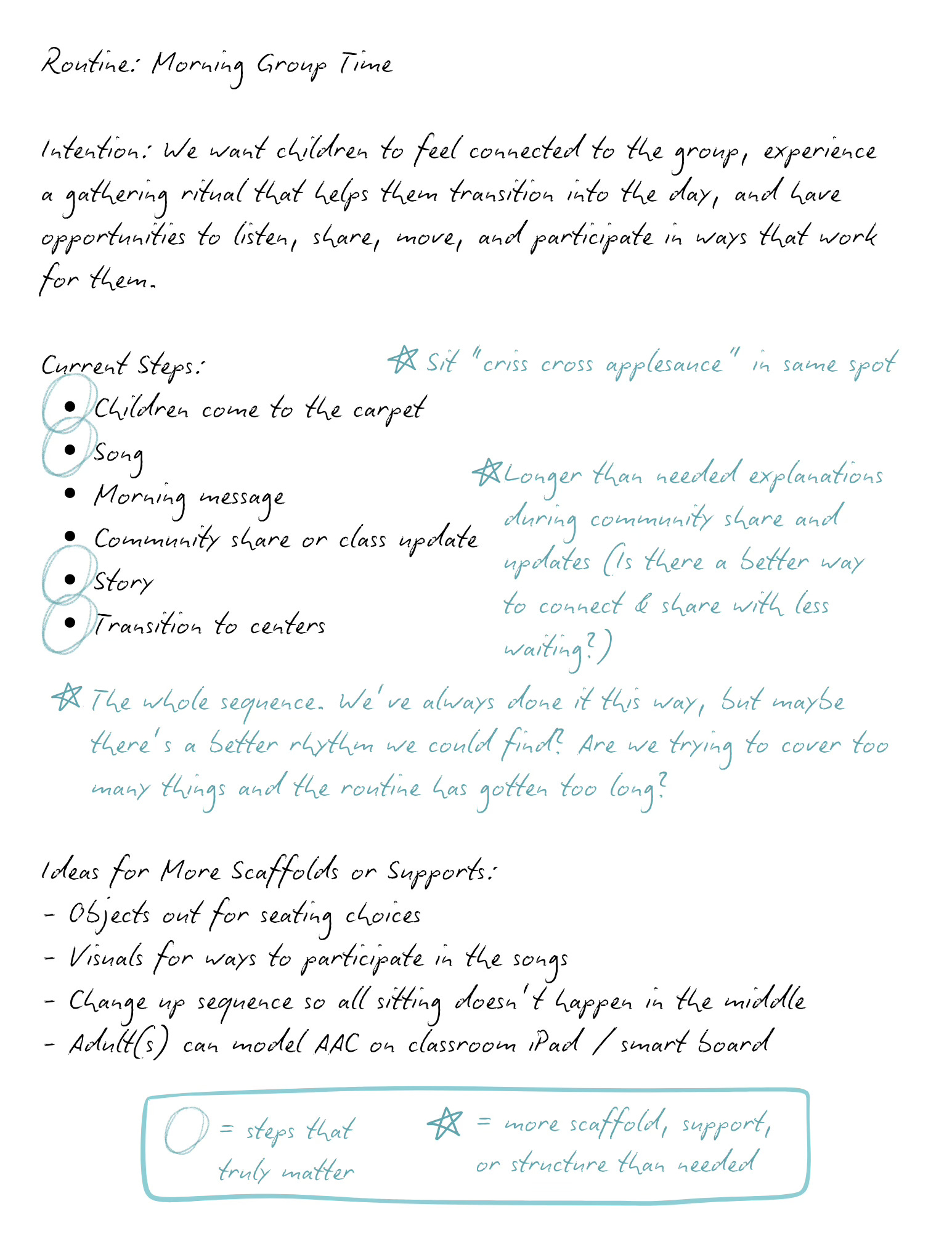
What do you want children to experience, learn, practice and feel during this routine or activity?List the steps you currently follow.
What happens first, next, after that, and so on?Circle the steps that truly matter.
Which steps support your named intention?Put a star by anything that might be more scaffolding than needed (for some children or all children).
What could be simplified, combined, or made more flexible?Notice where more scaffolds or support might actually help.
Are there parts of the routine where one or a few children would benefit from an added support that all children could choose, use, and even model when they want or need it?Create your new rhythm.
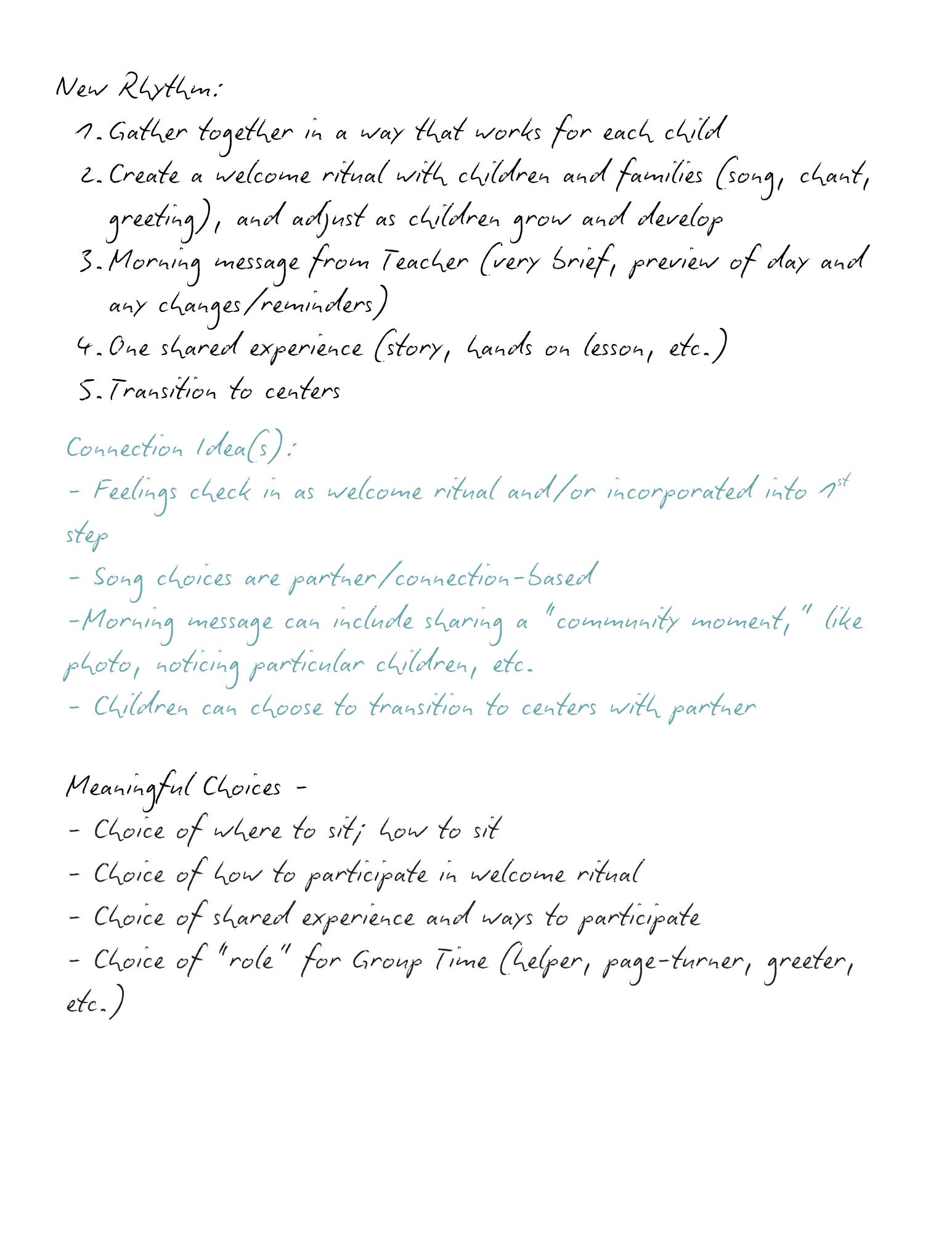
What’s a simple sequence that offers consistency without rigidity?Add an idea, or more than one, for connection.
What’s one way adults and/or children can connect with each other?Go back to step 5 and look at the places that could be more flexible.
Mark one or more places where children can make a meaningful choice. Bonus points for planning those meaningful choices while you’re at it.
Shift Happens: An Example
We try to be as universally designed in how we support adult learning as we hope you will be with young children. This graphic is for our more visual-minded readers and is meant to be an example of how an actual team might use the process. If you prefer, or need, a text only Google Doc version of the example, it’s available here: https://docs.google.com/document/d/1IbdyB3tvOXZfTutBW5KSDwj8P0yKsC6QHa79s9RGv1M/edit?usp=sharing
Tiny shifts matter a lot. We hope you’ll give it a try, make it yours, and tell us what you learn. We’re right here learning with you!
Keep choosing the humans over the steps,
Sally & Jackie